🏟️ The Cap Rate Playbook AT&T Stadium Is Writing for North Texas CRE Investors
The World Cup is moving the math on properties across DFW. How cap rate compression, a proven Atlanta blueprint, and a narrow post-tournament window will reward landlords who know how to read it.

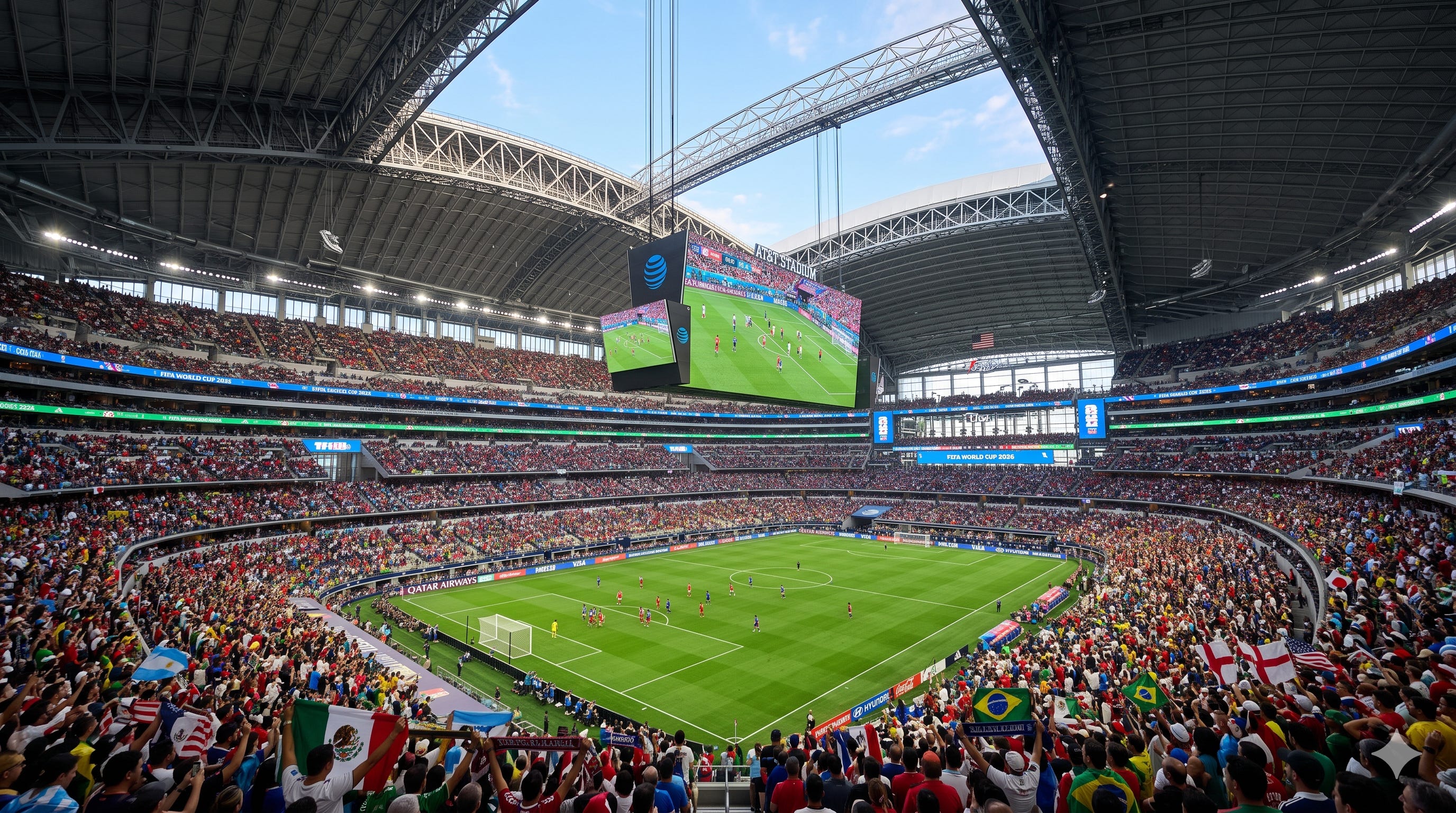
Five matches in. Four more to come. And AT&T Stadium, renamed Dallas Stadium for the World Cup, is already delivering something more valuable than highlight reels to a small group of North Texas investors — live, real-time proof of what this corridor can generate when the world shows up.
Ninety thousand fans per match. Parking lots on Collins Street running at capacity. Restaurants with two-hour waits. Hotels from I-30 to SH-360 at rates that would have seemed fictional eighteen months ago. The 2026 FIFA World Cup isn’t just putting soccer on a global stage in Arlington, it’s running a live economic stress test on the surrounding real estate, and the numbers are passing with room to spare.
Most people are watching the scoreboard. A smaller group is watching something more interesting: what’s happening to the underlying math of the properties surrounding the stadium. Understanding that math starts with what happened in Atlanta thirty years ago.
And Arlington isn’t the only North Texas market getting this treatment. Frisco is next, the PGA Championship lands at Fields Ranch in May 2027, and the same economic playbook is already being written for the Collin County corridor. More on the PGA Championship in Frisco soon.
🏛️ We’ve Seen This Movie Before
The 1996 Atlanta Olympics is the closest American precedent to what North Texas is hosting right now.
The wins were real. More than $5 billion in direct economic impact. Centennial Olympic Park became a permanent downtown redevelopment anchor that reshaped Atlanta’s core for decades. Corporate relocation interest accelerated through the late 1990s as companies that had never considered Atlanta suddenly put it on the short list.
The challenges were equally real. Infrastructure built for 16 days struggled to find permanent demand once the torch went out. Economic gains flowed unevenly, established property owners who were already positioned captured the appreciation, while small investors who hadn’t repositioned beforehand watched from the outside.
The investor lesson: the people who made generational returns from the Atlanta Olympics weren’t scrambling to buy during the Games. They bought 18 to 36 months before the torch lit and held through the post-event cooldown. The real value inflection came in the years after, as corporate headquarters, hotels, and mixed-use development followed the infrastructure the Games had built.
That lag is not a flaw in the pattern. It is the pattern.
🆚 DFW vs. Atlanta: The Honest Take
North Texas enters this from a position Atlanta didn’t have in 1996. DFW is already a top-4 metro economy with a corporate relocation pipeline moving aggressively before a single World Cup match kicked off. The distributed submarket structure, Arlington, Frisco, Plano, Irving, downtown Dallas all functioning as independent nodes, means economic lift spreads across multiple corridors rather than concentrating in one area searching for sustained demand.
The World Cup isn’t creating DFW’s momentum. It’s amplifying an already-moving train.
But the Atlanta traps are still live wires. Tournament infrastructure has to find permanent demand or it becomes expensive maintenance. Short-term hospitality spikes don’t automatically translate into long-term commercial occupancy gains. Investors who don’t understand submarket positioning may chase the event halo and buy the wrong zip code entirely.
The difference between capturing the Atlanta upside and stumbling into its mistakes comes down to understanding what an event like this does to the underlying math of surrounding properties. Which brings us to cap rates.
📐 Cap Rates: The Number That Actually Matters Here
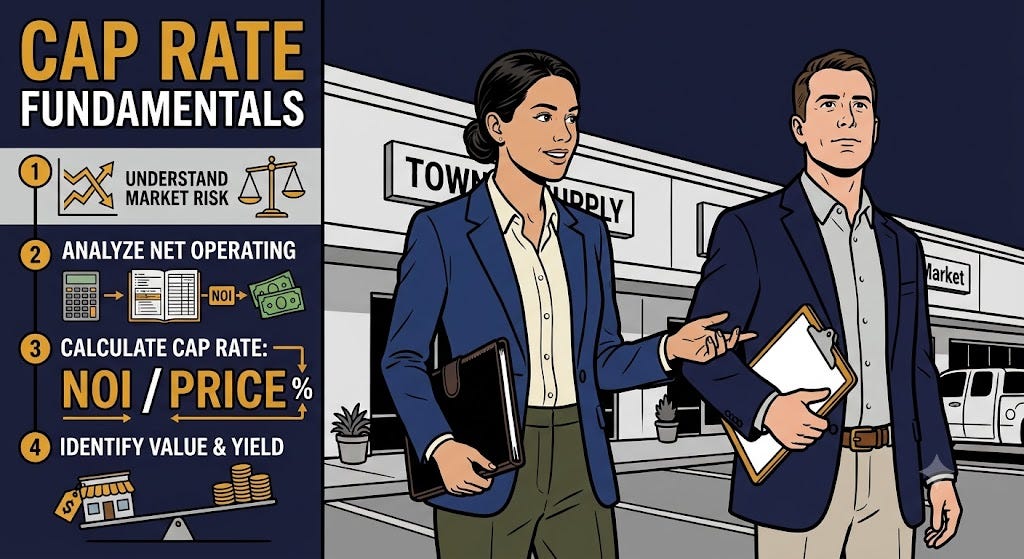
A cap rate (capitalization rate) is Net Operating Income divided by property value; the yield a property generates, independent of how it’s financed. Think of it as the interest rate on a savings account, but for a building.
> Cap Rate = Net Operating Income (NOI) ÷ Property Value
NOI is what a property earns after operating expenses but before debt payments. A property collecting $150,000 in rent and paying $30,000 in expenses has an NOI of $120,000.
AT&T Stadium is the perfect entry point for understanding this. On a sold-out match night, the NOI flowing through surrounding retail, parking, and hospitality near Collins Street is enormous. On a random Tuesday in February, those same properties run at baseline. That volatility is why lenders underwrite to stabilized NOI, the normalized, year-round income a property reliably produces. The World Cup isn’t changing stabilized NOI overnight. But it is proving what the ceiling looks like, and that matters more than most investors realize.
Put it in concrete numbers.
A 4-unit service retail strip on Collins Street in Arlington: $120,000 annual NOI, purchased for $1.8 million.
$120,000 ÷ $1,800,000 = 6.7% cap rate
A comparable property in Uptown Dallas with identical NOI but trading at $2.5 million due to location premium.
$120,000 ÷ $2,500,000 = 4.8% cap rate
Same income. Nearly a 2-point spread. That gap is what investors hunting the I-30/Arlington corridor are working with right now, buying real yield that Uptown buyers gave up long ago.
What the World Cup is doing to that math.
The tournament is giving landlords near AT&T Stadium something rare: live proof of demand at scale. Parking lots that typically run at 40% utilization are at capacity on match days. That data doesn’t disappear when the tournament ends, it becomes part of the NOI narrative a landlord takes to a lender or buyer. Investors who own stabilized NNN retail near the stadium corridor are building a tournament-tested story that will support cap rate compression arguments at refinance or sale.
Properties that might have traded at 6.8% cap rates before June 2026 could reasonably support 6.2% to 6.4% conversations once the full tournament is on the books. On a $2 million property, that’s a valuation difference of $150,000 to $200,000 — created not by improving the building, but by proving what the market around it can do.
The downside every first-time investor needs to see.
Cap rate compression is excellent when you already own. It is a real risk when you are buying.
If you purchase at a 5.5% cap rate and the market softens or rates rise, cap rates can expand. When that happens, your value drops even if income stays exactly the same.
A property generating $100,000 NOI at a 5.5% cap rate is worth $1.82 million.
Same property. Same $100,000 NOI. At a 6.5% cap rate: $1.54 million.
Same income. $280,000 less in value.
That is cap rate expansion risk. Know it before you buy into a compressed market.
One timing note: the NOI story from the World Cup will be freshest in the months immediately following the tournament. As the event fades from lender memory, its value as a negotiating data point weakens. Investors who want to use tournament-driven evidence to support favorable cap rate conversations have roughly 6 to 9 months after the final match before that data starts feeling dated.
📅 The Next 18 to 36 Months
0 to 12 months: Hospitality corrects as the spike normalizes; expected, not alarming. Industrial flex and service retail in the Arlington/Tarrant corridor should sustain elevated demand. Watch for pre-2022 owners near AT&T Stadium to explore exit or refinance strategies while the tournament NOI story is still fresh.
12 to 24 months: Companies whose executives experienced DFW during the World Cup begin formalizing office footprints here. Submarkets including Irving/Las Colinas, Uptown Dallas, and Frisco may see lease velocity increase before it shows up in published vacancy data. Investors who evaluate mixed-use retail or office/retail properties in these corridors now will be ahead of that data, not chasing it.
24 to 36 months: Permanent infrastructure improvements become the foundation for the next development cycle, the Centennial Park parallel. Watch Collins Street, I-30, and SH-360 in Arlington, and the US-380 corridor through Prosper and Celina. Atlanta investors who moved in 1994 saw fundamentally different returns than those who chased the market in 1997.
🔮 Our Take
The biggest plays in North Texas won’t be announced at a press conference. They’ll show up in a submarket absorption report, a road widening notice, or a corporate relocation filing, weeks before the mainstream conversation starts.
The World Cup is giving North Texas a global stage. The investors who treat that as an invitation to understand the underlying math, not just celebrate the moment, are the ones who will still be talking about 2026 in 2036.
---
Enjoying NTX CRE Insider? Subscribe for weekly insights into the deals, developments, and decision-makers shaping North Texas commercial real estate. Share this with anyone who deserves a real answer to: what is a cap rate?