The Dirt Is Cheap. The Water Will Cost You Everything.
Mehrdad Moayedi has developed 200,000 North Texas lots. When asked what's next, he said one word.

Last month, the UNT G. Brint Ryan College of Business assembled a panel on commercial real estate at the Omni PGA Resort in Frisco that was not a room you walk into casually. Rex Glendenning, four decades in the business and widely known as the King of Dirt, was moderating. To his right sat Stephen Jones, Cowboys Co-Owner and the executive who built AT&T Stadium and The Star in Frisco. Next to him, David Craig, who has owned, brokered, or developed more than 30 percent of McKinney’s entire incorporated land area. Then Mehrdad Moayedi, founder of Centurion American Development Group, the man whose company has put more than 200,000 lots across 75,000 North Texas acres into the ground. And rounding out the panel, Joe Hickman of Blue Star Land, the real estate development arm of the Cowboys organization. Also, Jason Ford, President of the Frisco EDC, was in the room, not on the panel, just listening.
When the conversation turned to challenges on the horizon for North Texas land development, Rex asked Moayedi, the most prolific land developer in North Texas history, what his biggest concern was moving forward.
He didn’t hesitate. One word. Water.
If you are a high-net-worth individual quietly eyeing a 30-acre parcel of North Texas farmland right now, drawn in by the price, the growth story, the idea that land is the one thing they are not making more of, that answer is the most important piece of due diligence you haven’t run yet.
The dirt may be priced like farmland. The day you decide to develop it, the water requirements will be something else entirely.
🏗️ One Square Mile. Two Completely Different Realities.
Here is the number that reframes everything.
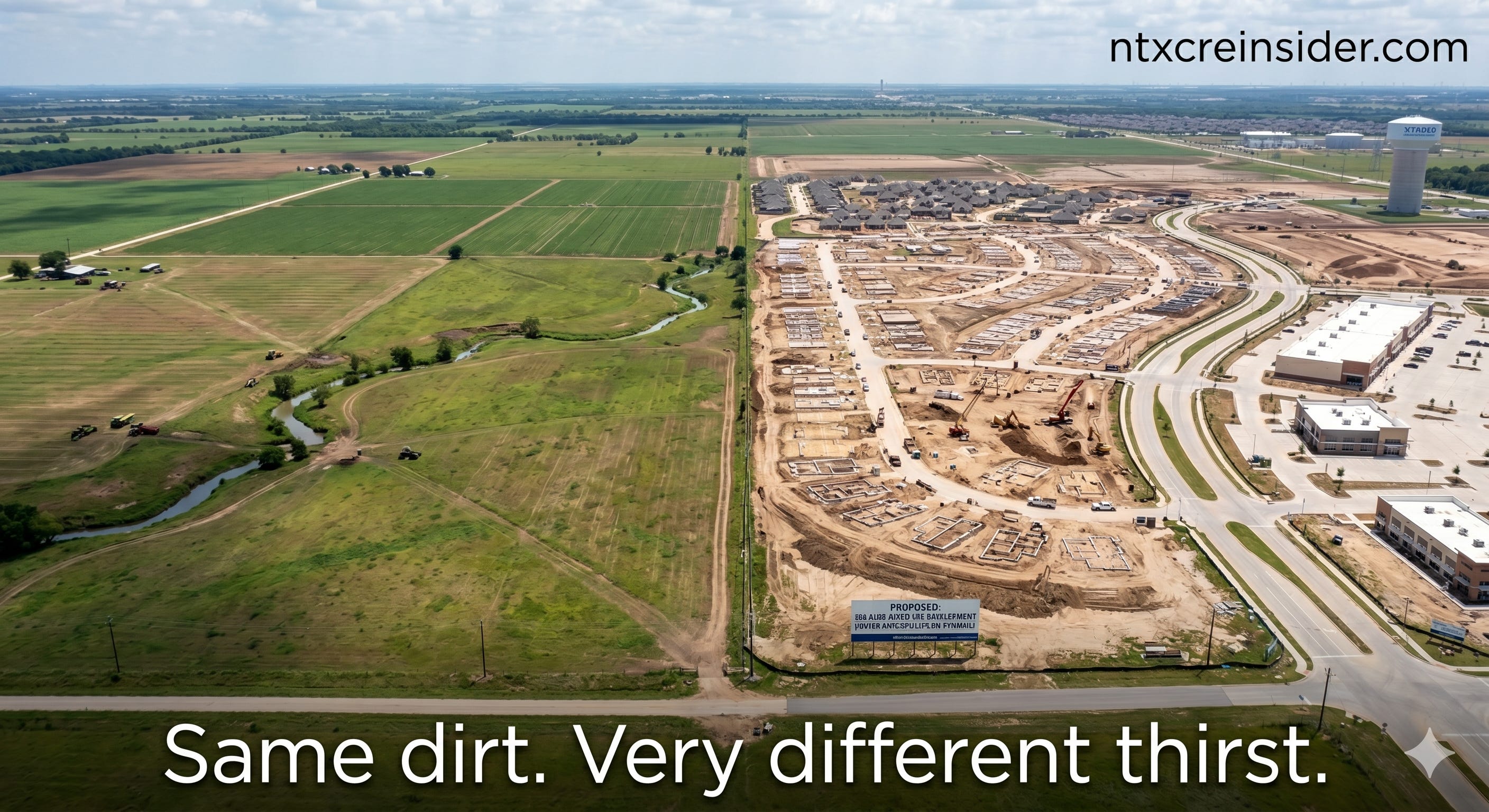
One square mile of active North Texas farmland; cotton, wheat, grain sorghum, draws water seasonally, through ground-level irrigation, at relatively low volume and pressure. A dry Texas summer might pull 400 to 600 acre-feet across a growing season from existing groundwater wells or rural water supply corporations built exactly for that purpose. Predictable. Cyclical. Manageable.
Now convert that same square mile to mixed-use development. Residential lots, a retail strip center, a flex building, a few restaurants. The water demand transforms completely. You are now running continuous, year-round consumption - treated, municipal-quality water delivered at high pressure through hundreds of individual meters. A single 300-unit apartment complex can draw 30,000 to 50,000 gallons per day at peak. Add commercial tenants, and that number climbs fast. The infrastructure designed to water a cotton field cannot be re-pointed at a master-planned community. It was never built for it.
The dirt is the same. The water requirement is a different universe.
📍 DFW Has Been Here Before — So Has Los Angeles
The historical parallel that makes this concrete: in the 1970s, Southern California’s growth machine was running at full speed. Developers pushed outward along new freeways, swallowing agricultural towns, Anaheim, Ontario, Irvine, one after another. For years, local groundwater kept pace. Then it hit a physical ceiling. Not a political one. The aquifers simply could not produce enough. Growth didn’t stop, but it sorted itself decisively and permanently. Communities plugged into major surface-water infrastructure, the Colorado River Aqueduct, the State Water Project, kept booming. Communities dependent on local groundwater stalled, or spent decades and hundreds of millions retrofitting what should have been underwritten before the first lot was sold.
North Texas in 2026 is at that same inflection point. Local groundwater in the outer growth corridors is under real pressure. The Woodbine and Trinity aquifers that served these communities for generations cannot carry large-scale development at the pace and density the Northbound corridor demands. Two new surface reservoirs are already beginning to redraw the viability map: Bois d’Arc Lake, the first major new reservoir built in Texas in nearly 30 years, now online and serving the North Texas Municipal Water District. And Lake Ralph Hall, scheduled for late 2026 delivery, directly in the path of the Sherman and Grayson County growth wave. The communities sitting on or adjacent to those supply lines will win the next growth cycle. The ones that aren’t will learn what LA learned, the hard way and on their own dime.
🛡️ What a First-Time Land Buyer Must Do Before Signing Anything
The standard farmland due diligence checklist, survey, title, environmental phase one, soil test, does not have water on it. It needs to be the first item, not an afterthought.
Before making an offer on any raw North Texas parcel, make one phone call. Call the local water district or rural water supply corporation serving that land and ask two direct questions: Can you issue a will-serve letter for this property at the density being planned? And what are the current water and wastewater impact fees — and when were they last adjusted? If those questions can’t be answered clearly and in writing, that’s the answer. Walk away, or price the infrastructure risk into the offer accordingly.
The smarter play is finding parcels that sit adjacent to recently extended municipal mains or newly funded infrastructure. In the Gunter and Van Alstyne corridors right now, major developers, the Centurion Americans of the world, are spending millions extending transmission lines as a condition of their own entitlements. The smaller parcels sitting immediately next to those funded extensions inherit the benefit without bearing the cost. That is the most powerful position available to a first-time buyer in this market: let the big player build the pipe, then buy the dirt next door.
🔮 Our Take
Moayedi didn’t say interest rates. He didn’t say labor or entitlement timelines or absorption risk. He said water, and without hesitation, which is the tell. When a man who has converted more North Texas farmland into rooftops than almost anyone alive names water as his primary constraint, in a room full of the people who built this market, the smart money updates its due diligence checklist accordingly.
The 30-acre parcel along the Northbound corridor might be the best land buy of your life. It might also be the most expensive education you ever receive. The difference between those two outcomes is almost always decided before the offer is written, by whether you understood what the land could actually drink.
In North Texas in 2026, the dirt is the easy part. The water is the deal.
Enjoying NTX CRE Insider? Subscribe for weekly insights into the deals, developments, and decision-makers shaping North Texas commercial real estate. Join the community of investors, brokers, and builders driving the next Texas boom.