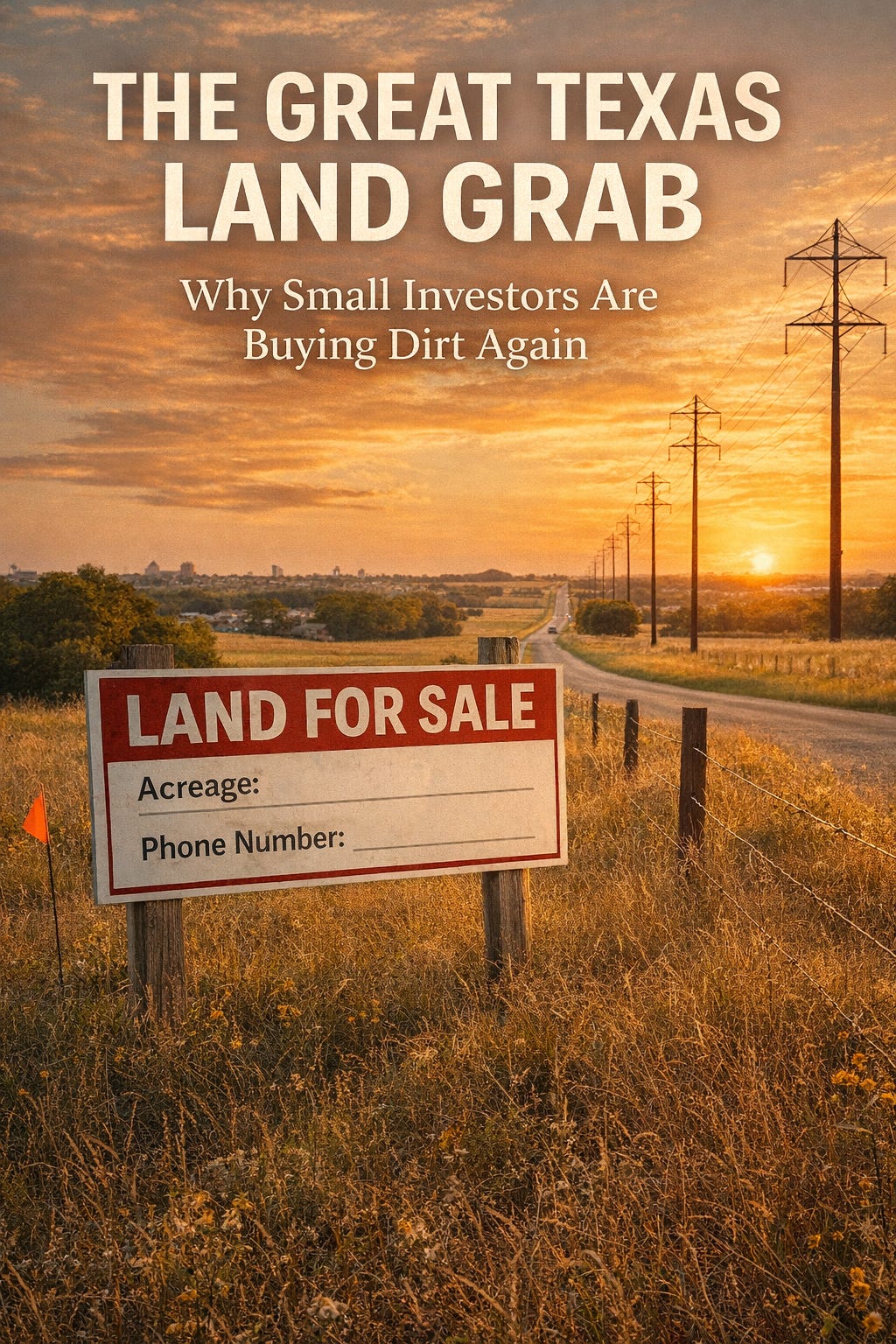
🏞️ The Great Texas Land Grab: Why Small Investors Are Buying Dirt Again
How North Texas farmland became the hottest asset class in the state.

Before a skyline rises, before a shopping center opens, before a subdivision takes shape — someone bought the land.
For decades, land investing in Texas was seen as a patient game for ranchers, families, and a few long-term institutional players. But something remarkable is happening across North Texas: small investors, first-time investors, and immigrant investors — especially from the South Asian community — are leading a new wave of land acquisitions.
And unlike past cycles, this land rush isn’t about speculation.
It’s about inevitability.
Welcome to the Great Texas Land Grab.
📈 Why Land Is Back: The Macro Story No One Is Talking About
Texas is adding more than 1,300 people a day, and the majority of them are landing in the Dallas–Fort Worth metro. Denton and Collin Counties are among the top 5 fastest-growing counties in the nation.
But here’s the real story:
Corporate relocations are accelerating
Talent migration from coastal states isn’t slowing
Infrastructure is expanding ahead of rooftops
Suburbs north of US-380 are entering Phase 1 of long-term urbanization
This combination hasn’t existed in Texas since the early 1980s — and it mirrors the early development patterns of Phoenix, Denver, Irvine, and even the outskirts of Chicago.
When population growth + infrastructure + corporate expansion align, land values don’t rise gradually.
They jump in stair-steps.
We’re in the middle of the next jump.
🛣️ The Outer Loop Changed Everything
If you trace nearly every major land boom in U.S. history, it starts with one thing: a new transportation spine.
Dallas had Central Expressway.
Frisco had the Tollway.
Now Celina, Prosper, Melissa, and North Denton County have the Outer Loop.
The planned 180-mile regional beltway will create:
New commercial nodes
Industrial corridors
Retail convergence points
Entirely new suburbs
Even though not all sections are built, land prices within 1–3 miles of the future loop have already jumped as much as 40–70% over the past 24 months.
Investors aren’t buying land for what it is — they’re buying land for what’s coming.
🏭 Sherman’s Industrial Boom Is Rewriting the Map
The most overlooked force in North Texas land demand?
Sherman.
Texas Instruments is investing over $30B into the area — the largest semiconductor expansion in U.S. history.
GlobiTech, Tyson, and other major employers are expanding quietly but significantly.
Result:
Melissa, Anna, Van Alstyne, and Howe are no longer “far out.”
They’re future bedroom communities for a new industrial supercluster.
Land from US-75 to US-377 is being accumulated like a rare asset.
Smart investors know:
Industrial jobs → housing demand → retail demand → land appreciation.
We’re watching that pipeline happen in real time.
💼 Meet the New Investor Class: The Rise of the South Asian Buyer
This is one of the most transformative shifts in North Texas investing.
Highly educated, high-income South Asian professionals — especially tech, finance, and medical — are becoming the most active buyers in the $300K–$3M land segment.
Why?
They understand long-term asset compounding
They prefer tangible, low-maintenance investments
They often pool capital through partnerships
They see land as generational wealth creation
In many ways, this mirrors the wave of European and Middle Eastern immigrant investors who transformed parts of New Jersey, Queens, Orange County, and Silicon Valley.
Immigration has always powered real estate booms.
North Texas is simply experiencing the next chapter.
📍 Where Smart Money Is Buying Now
Here are the strongest near-term and long-term land corridors:
1️⃣ East Princeton (FM 982 + US-380)
Massive residential growth → future retail nodes → rising land values.
2️⃣ North Celina / Preston to Outer Loop
Long-term premium corridor.
Think “future West Plano” but bigger.
3️⃣ South of Sherman (Melissa, Van Alstyne)
Industrial boom + housing shortage = appreciation runway.
4️⃣ Cross Roads / Aubrey / Krugerville
Hidden gems with retail gaps, strong schools, and proximity to Denton.
5️⃣ North Denton County (Ponder, Krum, Sanger)
Under-served, affordable, and sitting near future transportation arteries.
These aren’t speculative plays — they’re demographic plays.
🧠 The Case for Land: Why It Works in a Growth Market
Benefits:
Lower carrying costs
Minimal maintenance
Fewer tenant risks
Flexible exit options
Appreciation driven by macro trends, not micro tenants
Ideal for long-horizon investors (the NTX immigrant investor sweet spot)
Risks:
Entitlements take time
Utility extensions can be expensive
Zoning changes aren’t guaranteed
Liquidity varies by market cycle
But unlike office or multifamily, land doesn’t become obsolete.
It waits — and appreciates — as the city grows toward it.
🔮 Final Word: In North Texas, Buying Early Is Buying Smart
Every major metro has a window when land is still affordable and growth is accelerating — New York in the 1910s, Los Angeles in the 1950s, Phoenix in the 1980s, Austin in the 2000s.
For Dallas–Fort Worth, that window is now, especially in the northern arc.
The investors who look beyond today’s rooftops and visualize tomorrow’s corridors are the ones who will capture generational returns.
Because in North Texas, dirt isn’t just land.
It’s leverage.