🏀 The Mavs Aren’t Building an Arena. They’re Building a City.
What the Adelson Family’s 104-Acre Play Means for Every Commercial Property Owner in North Dallas

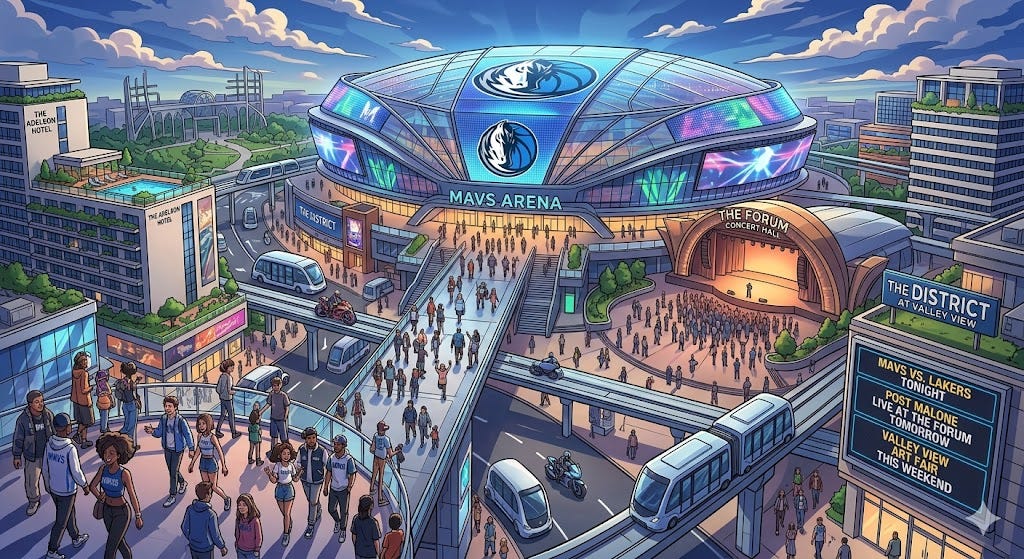
Most arena announcements are real estate stories dressed up in sports clothing. This one is different.
When the Dallas Mavericks locked down option agreements on 104 acres at the old Valley View Mall site along LBJ Freeway, they didn’t announce a new place to play basketball. They announced the construction of an entirely new urban district — one with its own hotel rooms, restaurant rows, retail corridors, entertainment venues, and eventually, its own gravitational pull on every surrounding block.
That is not an arena. That is a city-building exercise. And if you own commercial property anywhere near the LBJ–Preston corridor, you are now sitting inside the blast radius of one of the most significant urban development events in North Texas history.
🏙️ What “Building a City” Actually Means
The language around arena announcements is almost always sanitized into irrelevance. “Mixed-use development.” “Entertainment district.” “Vibrant destination.” These phrases get deployed so reflexively that they’ve lost all meaning.
So let’s be specific about what is actually being proposed at the Valley View site.
The Adelson family, through Patrick Dumont, are not sports owners who happen to be building an arena. They are the inheritors of the Las Vegas Sands model: vertically integrated, master-planned hospitality ecosystems where a single ownership entity controls the hotel, the arena, the retail, the restaurants, the convention space, and the parking. Every dollar spent inside the perimeter stays inside the perimeter. The Venetian. Marina Bay Sands. These are not venues. They are self-contained economic engines.
That is the blueprint being applied to 104 acres of North Dallas.
The ambition here is not to build something next to a city. The ambition is to build something that becomes the city — a district dense enough, programmed enough, and financially integrated enough to function as its own destination rather than a stop along someone else’s route.
For the surrounding neighborhood, that changes everything.
📍 Why Valley View — and Why Now
The site selection is not accidental, and understanding it matters for anyone trying to model what comes next.
Valley View Mall opened in 1973 as the premier retail destination of North Dallas — 1.2 million square feet anchored by Neiman Marcus, positioned at the intersection of LBJ Freeway and Preston Road, which at the time was as close to the geographic center of money in Dallas as any site in the city. It was glamorous, dominant, and culturally central for nearly two decades.
Then the suburbs kept moving north. NorthPark held its position. Galleria captured the luxury corridor. Valley View lost its anchors, lost its tenants, lost its identity, and eventually lost its buildings — demolished into a 100-acre concrete crater that sat largely dormant through the 2010s. The International District designation that followed gave the site a name but not a future.
What the Mavericks are inheriting is not a problem site. It is a blank canvas at one of the most accessible intersections in North Dallas, surrounded by established residential density, proximity to major employment corridors, and a daytime population that has nowhere adequate to go for major entertainment. The infrastructure already exists. The demographics already support it. What was missing was the capital and the vision to activate it.
Both have now arrived.
🏗️ The City-Building Playbook: What Gets Built Around the Core
Here is what urban economics tells us happens when a master-planned entertainment district of this scale lands in a supply-constrained submarket.
The core development, the arena, hotel, and primary retail, drives the first wave of foot traffic and demand. But the more powerful and lasting effect is what it does to the surrounding two-to-three-mile radius. A new city district of this scale creates demand that the core itself cannot satisfy. It needs more hotel rooms than it can build on 104 acres. More restaurant seats. More service businesses. More medical and wellness options for the workforce that will be employed there. More residential density for people who want to live near the action.
That overflow demand lands on the existing inventory surrounding the site. Your strip center. Your flex suite. Your second-generation retail space that has been sitting at $22 PSF NNN for longer than you’d like to admit.
The Arlington precedent is instructive but undersells what is coming here. When AT&T Stadium opened in 2009, it was a singular venue — powerful, but not a city-building exercise. The Valley View project, if executed at the scale the Adelson family’s track record suggests, will generate economic activity on a different order of magnitude. The comparison is less AT&T Stadium and more what happened to the neighborhoods surrounding Disney’s original Anaheim campus over a twenty-year period: sustained, compounding appreciation driven by a destination that kept growing rather than peaking.
📈 The Rent Horizon: From Stagnant to Structural
The historical baseline for the Preston–LBJ retail corridor is flat. Unanchored strip centers have traded in the low-to-mid $20s PSF + NNN for most of the past decade. There has been no compelling reason for national operators to prioritize 75240 over cleaner, newer inventory in Plano, Frisco, or along the Tollway.
That is the before picture. Here is the after.
As construction timelines solidify toward the projected 2031 opening, the rent trajectory in the surrounding corridor will move in three distinct phases:
2025–2028 — The Positioning Window. This is the most valuable period for independent landlords and the one most likely to be missed. Rents have not yet moved materially, but tenant interest is already shifting. National experiential operators — fitness brands, sports-adjacent food and beverage concepts, medical and wellness providers — are beginning to evaluate proximity to the site as a strategic variable. Landlords who restructure leases and lock in quality tenants during this window, with strong NNN structures and escalation clauses, will establish the rent basis that appreciates through the next two phases.
2028–2031 — The Construction Premium. As the district takes visible shape and the 2031 opening becomes an operational certainty rather than a planning document, rent pressure accelerates sharply. This is when REIT capital and institutional operators begin acquiring or leasing everything within range. Independent owners who have not repositioned by this point will face a choice between selling into peak land value appreciation or competing against institutional capital for tenant quality.
Post-2031 — The New Normal. Premier sports-adjacent experiential retail at $45 to $60-plus PSF + NNN is not a speculative projection — it is an Arlington-tested trajectory applied to a larger, denser, better-capitalized project. The corridor will not look like it does today. The landlords still standing in it at those rates will have earned every dollar.
🛡️ The Independent Landlord’s City-Building Strategy
The opportunity here is real. So is the risk of getting run over by it. Here is the framework for owners of one to five properties in the corridor.
Get in front of your leases before the cranes do. Month-to-month tenants and below-market renewals are your most urgent exposure. The leverage you hold today, when the site is still a planning document, is the highest leverage you will have until post-2031 stabilization. Use it. Structure new leases as NNN with 3%-plus annual escalations and fair market value resets at renewal. Every lease you sign in 2026 or 2027 under a legacy rate structure is money you are giving away permanently.
Treat the tax assessment as the enemy it will become. Dallas County appraisers respond to comparable land sales and permit activity, not opening dates. The assessment pressure will begin well before 2031, potentially as early as 2027, as land transactions around the site start establishing new comps. Engage a commercial property tax consultant now, establish your current value baseline, and file proactively. NNN lease structures that pass through tax increases are your primary defense, but only if they are already in place when the bills arrive.
Think about who the district’s workforce and visitors will need nearby. A city-sized entertainment district employs thousands of people and draws millions of visitors annually. Those people need urgent care, dentists, dry cleaners, gyms, tutoring centers, and every other service business that does not fit inside a master-planned entertainment complex. That demand is real, recurring, and largely immune to the economic cycles that hurt discretionary retail. If you are evaluating your tenant mix today, this is the category to prioritize.
Do not sell into the announcement. The worst possible outcome for an independent owner in this corridor is accepting a developer’s pre-announcement offer in 2025. Those offers are priced for the seller’s benefit, not yours. The gap between today’s land values and 2031 land values in a two-mile radius of this site will be measured in multiples, not percentages. Hold, improve, lease aggressively, and if you are going to sell, sell into the peak, not out of the announcement.
🔮 Our Take: North Dallas in 2036
The most useful thing we can tell you about what happens next is to look at what happened to the neighborhoods that surrounded Las Vegas Sands properties after they opened, not in the first year, but in years five through fifteen. The initial spike in land values and rents is real, but the more powerful effect is the sustained compression of vacancy and the permanent upward reset of what the market considers a reasonable rent.
That is what is coming to the LBJ–Preston corridor. Not a one-time event, but a permanent recalibration.
In 2036, Zip Code 75240 will not be recognizable as the submarket it is today. The independent landlords who understood in 2025 that the Mavericks were not building an arena but building a city, and who positioned their assets accordingly, will be sitting on the right side of one of the most consequential commercial real estate shifts in North Texas history.
The city is being built. The only question is whether you build with it.
Enjoying NTX CRE Insider? Subscribe for weekly insights into the deals, developments, and decision-makers shaping North Texas commercial real estate. Join the community of investors, brokers, and builders driving the next Texas boom.